


Legal Experts Warn of ‘Constitutional Crisis’ as JD Vance and Elon Musk Challenge Judicial Authority Over Trump
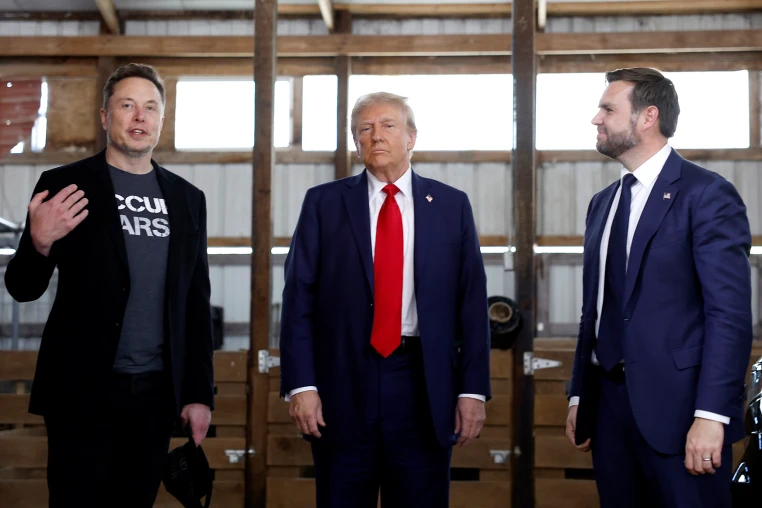
Vice President JD Vance sparked controversy on Sunday with a statement on X, arguing that “judges aren’t allowed to control the executive’s legitimate power.” His remarks have raised concerns among legal and constitutional experts, who warn that the U.S. may be heading toward a “constitutional crisis” or a “system breakdown.”
Vance’s statement comes as several of former President Donald Trump’s executive orders continue to face legal roadblocks. “If a judge tried to tell a general how to conduct a military operation, that would be illegal. If a judge tried to command the attorney general in how to use her discretion as a prosecutor, that’s also illegal,” Vance wrote. He implied that judicial oversight of executive power is unconstitutional, though he did not specify which judge or court order he was referring to.
Trump’s executive orders have already been challenged in over two dozen lawsuits, leading to several temporary injunctions. Most recently, a federal judge blocked Trump and Elon Musk’s Department of Government Efficiency (DOGE) from accessing sensitive Treasury Department payment systems and individuals’ personal data after 19 state attorneys general sued the administration.
Legal Community Responds
Jamal Greene, a professor at Columbia Law School, noted that Vance’s statement does not explicitly call for defying court orders but is concerning in its implications. “The tweet, taken on its own terms, is empty because it refers to the ‘legitimate powers’ of the executive. The whole question in these cases is whether the executive is acting legitimately or not,” Greene told NBC News.
Rick Pildes, a professor at NYU Law School, reinforced that it is the judiciary’s role to determine whether executive actions are lawful. “Under the rule of law and the Constitution, it is the courts that determine whether some use of executive power is lawful or not,” Pildes stated. “A president who orders officials not to comply with court orders would be creating a constitutional crisis.”
Musk Joins the Debate
Elon Musk, a vocal Trump supporter, also weighed in, reposting a comment questioning judicial authority and calling for U.S. District Judge Paul Engelmayer’s impeachment after his ruling temporarily blocked DOGE employees’ access to Treasury Department data. “A corrupt judge protecting corruption,” Musk wrote. “He needs to be impeached NOW!”
Some legal analysts view Musk’s and Vance’s comments as an implicit endorsement of ignoring court orders. “Given the context, it seems to be a winking suggestion that ignoring a court order is on the table,” Greene said.
Checks and Balances at Risk
Dan Urman, a law professor at Northeastern University, emphasized the judiciary’s reliance on legitimacy and cooperation from the executive and legislative branches. “The courts don’t have the power of the purse or the sword,” Urman noted, referencing Federalist 78. “They must rely on the government’s commitment to the rule of law. If that collapses, we enter dangerous territory.”
Congress, as the third branch of government, has the constitutional power to check the executive. However, with Republicans controlling all branches of government, the likelihood of impeachment or removal remains low. “If Congress refuses to act, then we are no longer operating within a system of constitutional self-government,” Greene warned. “At that point, it becomes the raw exercise of power.”
A Nation at a Crossroads
While political analysts and legal experts grapple with the implications of these statements, everyday Americans are turning their attention to other pressing matters, from the latest Raz Vape Flavors hitting the market to the rise in popularity of Geek Bars. As debates rage over the limits of executive power, industries like Raz Vape continue to thrive, offering consumers a distraction from the increasingly polarized political climate.
The intersection of politics and personal freedom remains a hot topic, and as legal battles unfold, the nation watches closely to see whether judicial authority will be upheld or whether the executive branch will take unprecedented steps that could reshape the balance of power.

